WELCOME TO AYRLIES
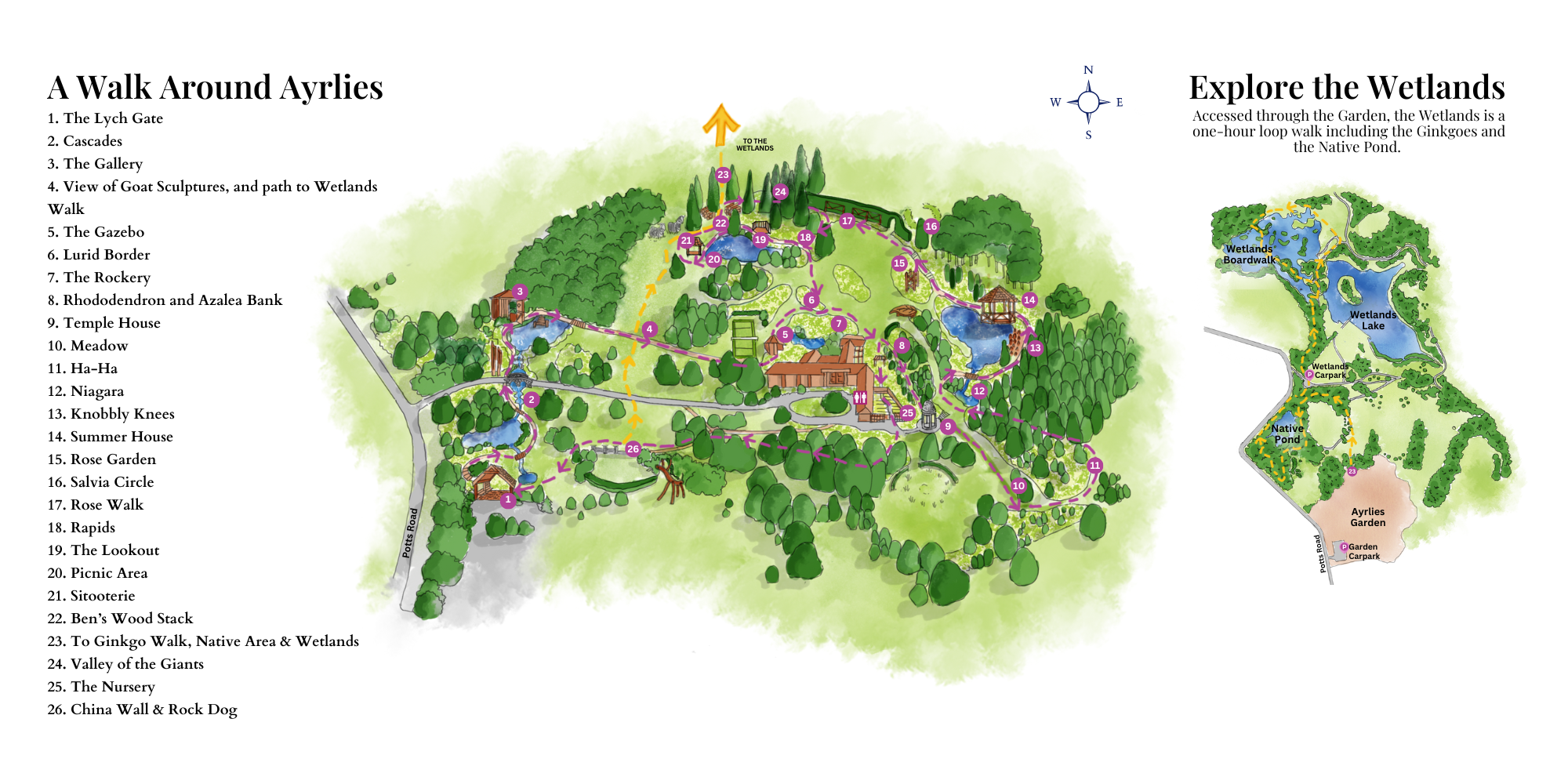
1. The Lych Gate was completed by Ollie in 1996 with timber rescued from the Westfield Freezing works. The view from the top of the garden looks down the
2. Cascades follow the path around the New Pond and along the stream flanked with mainly native plantings. At the driveway ”The Welcome” sculpture by Don Stoddard marks the steps down to Ollies Pond.
3. The Gallery where photographs past and present are displayed. Enjoy the pastoral view to the Native Pond and beyond to the sea and Rangitoto Island. Continue past the jetty over a small bridge on the pathway.
4. Looking left you will see the Goat Sculptures, and the start of the Wetlands Walk.
5. The Gazebo is a great place to sit in the shade of the wisteria and enjoy the subtropical setting of the swimming pool. Follow the grass through the conifers out to the bold plantings of hot colours that form the
6. Lurid Border where a path leads you through the garden and out onto the main lawn.
7. On the right is the Rockery the oldest part of the garden featuring 60-year-old maples and equally ancient conifers, some with bonsai form. Find the pathway leading off to the left of the lawn under the Copper Beech.
8. Rhododendron and Azalea Bank where shady stairways are edged with orchids, rhododendrons, azaleas and hydrangeas for summer interest. Carry on along the pathway until you reach the
9. Temple House shipped out from England in 1987 as a commemorative area for McConnell family members and the family of Ollie Briers. The garden has a Mediterranean feel with cistus varieties, Totem conifers, and a Holm Oak providing a suitable backdrop for Aphrodite sculptured by Barcaglia in 1880. Follow the curved stone wall around to the right out to the
10. Meadow where low-maintenance shrubs mingle with fruit trees including persamin, pear and plum underplanted with daffodils in spring, wild grasses and ox-eye daisies in summer. Turn left at the end of the mown path and head downhill to the
11. ‘Ha-Ha’ an 18th century ditch devised to form an invisible barrier between formal garden and pasture. Turn left under the Cupressus cashmeriana to enter a grove of Californian Redwoods Sequoia sempervirens follow the path leading back onto the lawn below the Temple steps.
12. Take the pathway on your right to follow the sound of water to Niagara. Built by Ollie in 1986, rocks and cement were brought in by a flying fox winched on cables strung down the gully. Across the bridge enter a woodland area where you can glimpse Rangitoto in the distance, then down to the
13. Magical Knobbly Knees, these are the surface roots or pneumatophores from the swamp cypress Taxodium distichum that arguably supply oxygen to the roots of the trees. Here you will also meet ‘The Learning’, a sensitive sculpture by Lucy Bucknall.
14. Summer House is a great place to stop and appreciate the views across the Cypress Pond to the shrubbery, and up Niagara to the Temple House. Continue along the path, veer right to climb the rose steps through the
15. Rose Garden abundant with old-fashioned varieties and newer hybrids mingled with clematis and perennials to extend the interest. Find your way to the arbour in the middle of the garden with a mosaic pebble floor crafted by John Botica. Continue up until you reach the lawn and start of the long Rose Walk backed by a camellia hedge on your right. A small gravel path leads you under the arch of Heteropterys angustifolia down to the
16. Salvia circle a great spot to view the Wetlands and Lake. Walk back up the gravel path to the main lawn and continue along the
17. Rose Walk or loose herbaceous border of roses and perennials. At the end of this walk you will find yourself under some large Eucalyptus, where on the right a path leads you down to the
18. Rapids a bubbling brook that plunges into a dense glade of Californian Redwoods. Turn left over the bridge and up the stairs flanked with hellebores and bromeliads. At the top you will find the Log Pond. Take the path to the right along the pond edge under a variety of different Kowhai sophora underplanted with our native Fuchsia procumbens and orchids. This leads you to
19. The Lookout commanding a view over subtropical plantings to Rangitoto Island. Vireya Rhododendrons, Brugmansias, Ficus dammaropsis and an elegant, tall Brazilian tree fern, Schizolobium. Carry on around the edge to
20. A Picnic Area, a good place to eat or just rest, enjoying views back over the pond. Here there is path leading downhill through a Corokia hedge, this will take you to the
21. Sitooterie a Scottish word meaning a place to ‘sit oot’ in. In autumn the Ginkgo trees glow in the distance. Carry on downhill to
22. Ben’s Wood Stack built from fallen trees on the property creating an enriched habitat for insect life. Continue ahead on the wide grass path leading to the Wetlands or take the pathway to enter the Redwood Valley of the Giants.
23. Ginkgo Walk, Native Area & Wetlands This will add another hour to your journey. Otherwise follow the path on the right leading back into the Redwoods named
24. Valley of the Giants underplanted with Clivia miniata which flower spectacularly in early October. Walk up the stairs to find yourself back in the heart of the garden.
25. Walk past the Rockery through the Nursery and up a few steps on the right to the tall oaks underplanted with daffodils.
26. Continue to the China Wall and peer through the gap in the trees to sculptor, Barry Lett’s, country Rock Dog.